

Industrial and warehouse buildings in Murfreesboro, TN, have been multiplying fast as middle Tennessee’s logistics and manufacturing sectors have grown, and with that growth comes a category of roofing work that most general commercial contractors are not fully equipped for. Flat roof repair on a large industrial building is a different undertaking than patching a retail strip center, and the gap in knowledge shows up clearly in how long those repairs last. At Glick Roofing Systems, we work on industrial and commercial buildings across Tennessee and know what flat roof repair on these structures actually requires. Call us at (800) 821-0205 to schedule an inspection of your facility.
Industrial Flat Roof Repair Is Different
Murfreesboro sits in the heart of Middle Tennessee’s fastest-growing commercial corridor. Distribution centers, manufacturing plants, cold storage facilities, and large warehouse complexes are all common building types in the area, and nearly all of them share one thing: a large flat or low-slope roof that takes everything Tennessee’s climate can deliver. Hot, humid summers. Severe storm seasons bring heavy rain and occasional hail. Temperature swings between seasons that stress every seam and flashing detail. Flat roof repair on these buildings must account for the scale, the operational constraints, and the climate-specific failure patterns that are unique to this region.
The first difference is scale. A flat roof repair on a 300,000 square foot distribution center covers a lot more ground than a typical commercial repair job, and the complexity goes up accordingly. Drainage systems on large industrial roofs involve multiple drain fields, internal drains, overflow scuppers, and sometimes crickets and tapered insulation sections that direct water across a significant surface area. A repair contractor who does not understand how that system works as a whole can fix a visible leak at one location while missing the drainage issue three hundred feet away that is causing water to pond and stress the membrane in the same zone. Industrial flat roof repair requires a full-roof perspective, not just a response to the symptom that showed up on the interior ceiling.
Climate Impact on Industrial Flat Roof Repair
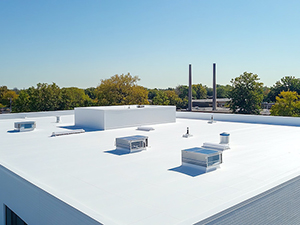
Middle Tennessee’s climate puts industrial flat roofs through a demanding annual cycle. Summer heat in Murfreesboro pushes rooftop surface temperatures well above ambient air temperature, and the daily expansion and contraction that results stresses membrane seams and flashings continuously from May through September. Humid conditions mean that any opening in the membrane, however small, has moisture available to infiltrate the insulation layer below. Tennessee’s spring storm season adds wind-driven rain, hail impacts, and occasional debris damage to that baseline thermal stress. The result is a set of flat roof repair needs that compound each other. A seam that opens slightly under heat stress becomes a moisture entry point during the next storm. Identifying and addressing that connection rather than treating each failure in isolation is what separates a repair that holds from one that comes back.
Operational Constraints
Flat roof repair on an active industrial facility is not just a roofing problem. It is a logistics problem as well. A distribution center moving freight around the clock cannot have sections of the roof open to weather. A cold storage facility has temperature requirements that make interior exposure unacceptable. A manufacturing plant with overhead equipment or sensitive inventory needs repair work staged so the production environment below is never compromised. At Glick Roofing Systems, we plan every industrial flat roof repair project around the facility’s operational reality. That means pre-project communication with the facility team, staged work sequencing that keeps the roof closed throughout, and a schedule that respects shift operations and production commitments.
The Glick-Guard Warranty
For industrial building owners and facility managers, a repair warranty that actually holds up matters more than it might on a smaller commercial project. The stakes are higher, the roof areas are larger, and the cost of repairs that fails and has to be redone is significant. The Glick-Guard warranty covers both labor and materials on every qualifying flat roof repair project with no-dollar-limit language, meaning there is no ceiling on what a covered repair will cost Glick to make right. The warranty terms are written clearly and provided before the project starts, not handed over after the crew has left the site. For industrial facilities in Murfreesboro that need to know their investment is protected, that documentation matters.
Industrial Flat Roof Repair
Industrial buildings in Murfreesboro, TN deserve flat roof repair contractors who understand the scale, the systems, and the operational requirements that come with this category of work. At Glick Roofing Systems, we bring the experience and the manufacturer relationships with GAF, Duro-Last, Carlisle, Conklin, and American Weatherstar to handle industrial flat roof repair correctly the first time, backed by the Glick-Guard warranty on every project. Call us at (800) 821-0205 and let us assess your facility and tell you exactly what the roof needs.
FAQ
Can Glick Roofing complete flat roof repairs on an active industrial facility?
Yes, Glick plans and stages all industrial repair work to operate around active production and facility schedules with no disruption to building operations.
How does flat roof repair on a metal warehouse differ from membrane repair?
Metal roofs require repair systems that account for thermal movement, typically reinforced coating solutions over prepared seams and fasteners rather than standard patch applications.
What does the Glick-Guard warranty cover on a flat roof repair project?
Glick-Guard covers both labor and materials with no-dollar-limit language and includes leak coverage, with clear written terms provided before any project begins.
Does Glick Roofing serve industrial buildings outside Murfreesboro?
Yes, Glick Roofing serves commercial and industrial buildings across Tennessee and into Kentucky, Georgia, Alabama, Mississippi, North Carolina, South Carolina, Arkansas, and Texas.