
Alabama summers are brutal on commercial roofing systems, and a roof coating is one of the most effective tools available to commercial property owners in Hoover, AL, who want to fight back against heat-driven membrane deterioration and rising energy costs. At Glick Roofing Systems, we install reflective roof coating systems on commercial and industrial buildings across Alabama, and the performance difference on a properly coated roof is measurable from the first summer season. Call us at (800) 821-0205 to find out whether your building is a candidate.
Can Roof Coating Protect from Sun Damage?
This article covers exactly how reflective roof coatings work against Alabama’s heat, what they do to surface temperatures and HVAC loads, how they protect the membrane underneath, and why they make strong financial sense for commercial building owners who want to get more life out of their existing roof system.
A dark commercial roof membrane in Hoover, AL can reach surface temperatures of 150 to 180 degrees Fahrenheit on a clear summer day. At those temperatures, the membrane is not just warm, it is under continuous thermal stress. The repeated expansion and contraction that occurs as the roof heats through the day and cools at night creates mechanical fatigue in the membrane over time, accelerating cracking, seam separation, and surface erosion. Flashing details at penetrations and edges are particularly vulnerable because they experience the most movement. UV radiation compounds the damage by breaking down the molecular structure of most roofing membranes, reducing flexibility and accelerating the brittleness that leads to cracking. Alabama’s combination of intense sun, high humidity, and summer heat creates one of the more demanding environments a commercial roof can face, and an uncoated dark membrane absorbs all of it.
How Roof Coatings Reflect Heat and Protect the Membrane
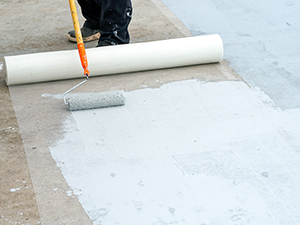
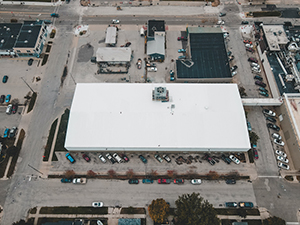
Reflective roof coatings work by dramatically increasing the roof surface’s solar reflectance, which is its ability to redirect solar energy away from the building rather than absorbing it. A quality white or light-colored elastomeric coating can reflect 80 to 85 percent of solar radiation, dropping surface temperatures by 50 to 80 degrees Fahrenheit compared to an uncoated dark membrane. That reduction in surface temperature directly reduces the thermal cycling stress the membrane experiences daily, slowing the deterioration process that would otherwise shorten its useful life. The coating also acts as a physical barrier between the membrane and UV radiation, oxygen, and moisture, shielding the underlying material from the environmental exposure that degrades it fastest. On an older membrane that still has structural integrity but is showing early signs of UV wear, a coating system can realistically add 10 to 15 years of service life.
The HVAC Impact of a Reflective Roof Coating
When a commercial roof surface is running at 160 degrees, that heat transfers through the roof assembly and into the building’s interior, increasing the cooling load on the HVAC system. For large commercial buildings with significant roof area, this heat gain is substantial and directly translates to higher electricity consumption during the months when Alabama utility costs are already at their peak. A reflective roof coating reduces heat transfer at the source. Building owners who have installed quality reflective coatings on commercial properties in the Southeast routinely report cooling cost reductions in the range of 15 to 30 percent during summer months, depending on the building’s insulation levels, HVAC efficiency, and roof area relative to total building square footage. For a large commercial building running air conditioning for eight or more months of the year, that reduction adds up to meaningful savings across every cooling season for the life of the coating.
Roof Coating Long-Term Value for Alabama Buildings
The cost of a professionally applied commercial roof coating is significantly lower than a full roof replacement, typically running a fraction of replacement cost depending on the system selected and the roof’s current condition. When energy savings, extended membrane life, and deferred replacement costs are factored in, the return on investment for a well-executed coating project is compelling. Many qualifying reflective roof coating systems also meet Energy Star standards, which can support eligibility for commercial energy efficiency tax deductions that further improve the financial case. For a commercial building in Hoover whose roof still has structural integrity but is losing the battle against Alabama heat, a coating system is often the most cost-effective path forward.
Alabama Roof Coating Professionals
A reflective roof coating gives commercial building owners in Hoover, AL a practical, cost-effective way to fight back against heat damage, reduce energy costs, and extend the life of an existing roof system. At Glick Roofing Systems, we assess, prepare, and apply commercial roof coating systems across AL with the workmanship and warranty backing to make the investment stand up long term. Call us at (800) 821-0205 and let us take a look at what your roof needs before the next Alabama summer arrives.
FAQ
Does roof coating change the appearance of a commercial building?
Most commercial elastomeric coatings are white or light gray, giving the roof a clean, uniform appearance that many building owners consider an aesthetic upgrade.
Can a roof coating be applied over a wet or damp membrane?
No, proper surface preparation requires a completely dry substrate, which is why moisture testing is a standard part of the pre-application inspection before any coating work begins.
How many coats are typically applied on a commercial roof?
Most commercial coating systems require two coats applied in opposing directions to achieve the specified dry film thickness.
Can a roof be recoated at the end of the coating’s service life?
Yes, one of the significant advantages of elastomeric coating systems is that they can be cleaned, primed if necessary, and recoated to renew the warranty and extend protection.