

Modified bitumen covers a lot of Nashville commercial roof area, much of it installed decades ago and still working. These roofs tell you when they are in trouble, though the signals are easy to walk past. Reading them is what turns bitumen roof repair from an emergency into scheduled work, and at Glick Roofing Systems we assess mod-bit roofs across Middle Tennessee.
Call Glick Roofing Systems at (800) 821-0205 for bitumen roof repair in Nashville, TN.
Assessing the Blisters Before Booking a Bitumen Roof Repair
A blister is a pocket of trapped air or moisture between roof layers that expands when the sun heats it. Nashville summers give them plenty of energy to work with.
Small blisters that stay intact are usually monitored rather than opened, because cutting into a sound blister creates a repair where none was needed. Blisters that have grown, that sit in a traffic path, or that have already split are a different matter. Once the top layer breaks, the pocket becomes an entry point.
The repair means cutting out the blistered area down to sound material, drying what is underneath, and rebuilding the layers with new membrane properly adhered and lapped into the surrounding roof. The cause must be addressed too. Blisters usually mean moisture found its way into the assembly, and a repair that does not find that path will repeat itself a few feet away within a couple of years.
Seam Separation and Splits
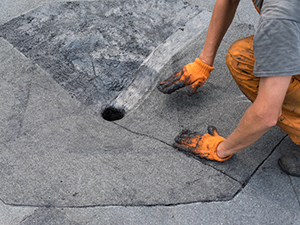
Mod-bit sheets overlap and bond at the laps using torch-applied, hot-mopped, or cold-adhesive methods. Every day the roof heats and cools, the sheets move, and the seam absorbs that movement.
Over enough cycles the bond fatigues. It shows first as a lifted edge, sometimes barely visible, sometimes just a line that catches debris differently than the rest of the roof. A split is further along: the membrane has torn, usually in a straight line following a joint in the deck or insulation below.
Repairing a seam means cleaning and drying the area, reactivating or replacing the bond, and covering the repair with reinforcing material carried well past the damage in both directions. Splits over deck joints need a detail that allows continued movement, because patching over a moving joint produces the same split again in the same place.
Alligatoring and Flashing Failures on Bitumen Roofs
Alligatoring is the cracked, scaled surface pattern that appears on aging asphalt as UV oxidizes it. The surface hardens, loses flexibility, and cracks into a pattern that looks like reptile skin.
Shallow surface alligatoring on an otherwise sound roof is often handled with a surfacing or coating that restores UV protection. Where the cracking has worked down into the reinforcement layer, those sections have to be replaced. Telling the difference requires cutting a test area rather than judging from the surface.
Flashing deterioration around penetrations is the fourth failure and the one that causes the most interior damage. Base flashing at curbs and walls pulls away as the substrate moves, sealant at pipe penetrations hardens and cracks, and metal counterflashing loosens. Water entering at a penetration travels inside the assembly, so the ceiling stain rarely appears below the actual opening. A proper repair rebuilds the flashing detail from the substrate out rather than adding sealant to a failed one.
Timing Bitumen Roof Repair on a Nashville Building
Every one of these conditions gets more expensive the longer it runs, because the scope migrates from the membrane into the insulation and the deck. A roof inspected regularly lets you handle blisters, seams, surface wear, and flashings as maintenance items rather than emergencies. Our team assesses what is actually failing and backs the work with written terms through our Glick-Guard warranty.
For bitumen roof repair in Nashville, TN, contact Glick Roofing Systems at (800) 821-0205 today.
FAQ
How long does a modified bitumen roof last in Tennessee?
Most systems run 15 to 25 years, with surfacing condition, drainage, and how promptly flashing issues were handled accounting for most of the spread.
Can a mod-bit roof be repaired in cold weather?
Yes, though torch-applied and cold-adhesive methods have temperature limits, and a repair made below them often has to be redone.
When is replacement the better call than repair?
When wet insulation is widespread, when the surface has failed across most of the roof, or when repairs keep appearing in new locations each season.