

Commercial property owners in Nashville, TN have several options when choosing a roofing system for a flat roof. Foam roofing differs from traditional membrane systems because it is sprayed directly onto the roof and expands into a seamless, fully adhered surface. Understanding how spray foam compares with other roofing materials can help property owners determine which system best matches their building and long-term needs.
Glick Roofing Systems handles foam roofing projects in Nashville, TN. Call (800) 821-0205 to determine whether foam roofing is the right solution for your commercial property.
A properly installed foam roof can provide seamless waterproofing, added insulation, and dependable long-term protection for a commercial building.
Foam Roofing vs. Other Options
Common flat roofing membranes are installed in sheets or rolls. TPO and EPDM are single-ply systems with sections joined at the seams, while modified bitumen is an asphalt-based system installed in multiple layers. Each has a long history of use on commercial roofs.
Foam roofing is installed differently. The material is sprayed on as a liquid, expands into a solid layer, and is finished with a protective coating. Because it forms directly on the roof, it creates a continuous surface without the field seams found in membrane systems. That difference influences everything from installation to long-term maintenance.
Installation Disruption and Insulation Value
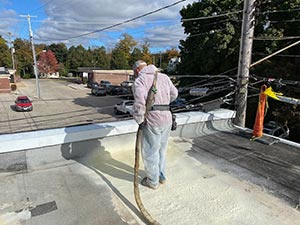
Foam can often be installed over an existing roofing system when conditions allow, reducing the amount of tear-off and disruption to the building below. The foam also adds insulation as part of the roofing system, improving thermal resistance without relying entirely on separate insulation beneath the roof.
Membrane systems have installation advantages of their own. They can generally be installed under a broader range of weather conditions, while spray foam requires a dry surface and suitable wind conditions for proper application. On a large, open roof with few penetrations, a single-ply membrane may also be relatively straightforward to install. Foam can be applied at varying thicknesses, allowing trained installers to address minor low areas and help direct water toward existing drainage.
Seam Risk and Penetration-Heavy Roofs
Seams are a common point of concern on flat roofing systems because they can become vulnerable as the roof ages or moves. Foam eliminates field seams by creating one continuous surface across the roof. It can also conform closely around curbs, pipes, drains, and other penetrations without requiring the numerous cuts and seams that sheet materials may need.
This can make foam particularly useful on roofs with extensive equipment or irregular details. On a large, open roof with relatively few penetrations, properly installed and maintained membrane seams can perform reliably, making the seamless construction of foam less of a deciding factor.
Where Foam Roofing Wins (And Where It Loses)
Foam roofing earns its place on complex roofs, on buildings that benefit from added insulation, and where avoiding a full tear-off is worth a lot. It is also a strong candidate on irregular rooflines that would take many cuts and seams in a sheet system. Its trade-off is upkeep, because the protective coating has to be renewed periodically to keep the foam sound.
A membrane system can be the more practical pick on a large, simple roof, or where a schedule for recoating is not realistic. The right answer follows the building, not whichever system sounds best in the abstract.
Choosing Foam Roofing for Your Nashville Building
Foam roofing and membrane systems approach commercial roof protection differently, making the building itself an important part of choosing between them. A roof with numerous penetrations, equipment, and complex details may benefit from a seamless foam application, while a large, open roof may be well suited to a membrane system. The right choice depends on the existing roof and the property’s long-term needs.
Glick Roofing Systems handles foam roofing projects in Nashville, TN. Call (800) 821-0205 today to determine whether foam roofing is the right solution for your commercial property.
Matching the roofing system to the building can improve performance, simplify future maintenance, and help property owners get greater long-term value from their investment.
FAQ
How long does a foam roof last, and how often does it need recoating?
A well-maintained sprayed foam roof can perform for decades, but the protective coating over it wears and has to be renewed on a cycle, often every ten to fifteen years. Keeping up with recoating is what separates a foam roof that lasts from one that fails early.
Can foam roofing be installed over an existing roof?
In many cases yes, which is one of its advantages, since spraying over a sound existing roof can avoid a full tear-off. The roof below has to be dry and stable first, so a moisture check comes before any foam is applied.
Is foam roofing cheaper than a membrane system over its lifetime?
It depends on how the roof is managed. Foam can avoid tear-off and lower energy use, which helps its lifetime value, but only if the recoating schedule is kept, since a neglected coating shortens its life and erases that advantage.