
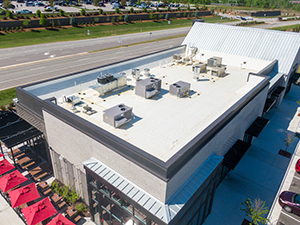
One of the most costly mistakes a commercial building owner can make is replacing a roof too early, while waiting too long can lead to even greater damage and expense. Determining whether flat roof replacement is the right decision requires more than reacting to visible issues like leaks. A proper evaluation looks at the full condition of the roofing system to understand what is actually happening beneath the surface.
Glick Roofing Systems provides commercial flat roof assessment and replacement services for properties in Murfreesboro, TN and across Middle Tennessee. Call (800) 821-0205 to find out where your roof stands and whether replacement is the right next step.
Do You Need A Roof Replacement? How Do You Know?
A leaking flat roof does not automatically mean the roof has failed. Many commercial buildings in Murfreesboro develop leaks at specific points, often from a flashing separation at an HVAC curb, a failed seam lap, or a cracked penetration seal, while the rest of the membrane is still holding up. In these cases, a targeted repair or restoration costs far less than a full replacement and can extend the roof’s performance for years.
Full replacement is a different situation. It comes into play when there is widespread membrane deterioration, multiple areas of saturated insulation, structural deck damage, or when the system has reached the end of its service life and is breaking down across the entire surface, not just in isolated spots.
Knowing the difference comes down to a proper assessment. That means getting on the roof with the right tools and inspecting the system as a whole, not making assumptions based on what you see from inside the building.
The Diagnostic Steps Preceding a Flat Roof Replacement

A flat roof assessment that produces a reliable replacement-or-not answer involves three things most building owners do not think to ask for. First, core cuts are pulled from multiple locations across the roof to check whether the insulation beneath the membrane is wet or dry. Wet insulation that has been accumulating moisture for multiple seasons is one of the clearest signals that a roof has moved past repair territory, because saturated insulation cannot be dried in place and must be replaced along with the membrane above it. Second, a full seam and lap inspection across the roof field to determine whether failures are isolated or systemic. Third, a deck inspection to confirm whether the structural substrate is still sound enough to support a new membrane assembly. These three data points, taken together, tell you what decision to make.
Tear-Off vs. Recover
When replacement is the right call, the next step is deciding whether a recover is a viable option. A recover installs a new membrane system over the existing roof without removing the old one. This approach reduces project time, labor, and disruption to the building.
Tennessee building code typically allows one recover layer over an existing roof, but only under the right conditions. The deck must be structurally sound. The existing membrane must be dry and properly adhered. The added weight must also fall within the building’s load capacity. When all of these boxes are checked, a recover can be a practical and cost-effective solution.
A full tear-off becomes necessary when those conditions are not met. Wet insulation, deck deterioration, or an existing recover layer already in place all rule out another overlay. In these cases, the system has to be removed down to the deck and rebuilt the right way.
Any contractor who recommends a recover without confirming these conditions is not protecting your building. They are skipping steps in the assessment, and that usually leads to bigger problems later.
What Middle Tennessee’s Climate Does to Flat Roofs
Murfreesboro’s climate is harder on flat roofing membranes than most building owners appreciate. Summer UV intensity at Tennessee latitudes accelerates surface oxidation on membranes that are already past their peak flexibility. High summer humidity keeps moisture levels elevated in any area where the membrane has even minor surface degradation. Winter ice events, while infrequent, create freeze-thaw stress at seams and flashings that compound year over year. A flat roof that was installed 15 years ago and has never been professionally assessed has almost certainly accumulated damage across at least one of those fronts, and the difference between a roof that gets restored and one that ends up needing full replacement often comes down to whether that damage was caught and addressed before it spread through the assembly.
Flat Roof Replacement Specialists
Before committing to a flat roof replacement, it is important to get an honest assessment of what the roof actually needs. Not every issue requires full replacement, and a proper evaluation can help determine whether repair, restoration, or replacement is the right path forward.
Glick Roofing Systems provides commercial flat roof inspection and replacement services for properties in Murfreesboro, TN and across Middle Tennessee. Call (800) 821-0205 to get a clear, straightforward assessment before making a major roofing decision.
FAQ
How long does a flat roof replacement typically take on a mid-size Murfreesboro commercial building?
Most mid-size commercial flat roof replacements complete within three to seven days depending on roof complexity, deck condition, and weather.
Can flat roof replacement be done in phases on a large commercial building?
Yes, large roofs can be replaced in sections to manage budget cycles or minimize operational disruption, provided temporary waterproofing is maintained at each phase boundary.
Does flat roof replacement require the building to be vacated in Murfreesboro?
In most cases no, though noise, temporary odors from adhesives, and equipment access near the building perimeter are communicated to tenants before work begins.
What membrane types are most common for flat roof replacement in Tennessee?
TPO and PVC are the most widely specified single-ply options for Tennessee commercial flat roofs, with EPDM used in applications where budget is the primary driver.