
A patch on a rubber roof is only as reliable as the contractor performing the repair. EPDM membrane has specific repair requirements, and when those steps are not followed correctly, a repair may appear solid at first but fail once Middle Tennessee experiences heavy rain or prolonged weather exposure. Proper rubber roof repair in Murfreesboro, TN requires identifying the true source of the issue, matching the repair method to the type of failure, and using compatible materials that properly bond to aged EPDM.
Glick Roofing Systems provides EPDM and rubber roof repair services for properties in Murfreesboro, TN and the surrounding Middle Tennessee region. Call (800) 821-0205 to schedule a roof assessment and have your system evaluated by professionals who understand what they are looking for.
Why Rubber Roof Repair Fails
EPDM is a rubber membrane, and rubber behaves differently from the thermoplastic membranes like TPO and PVC that now dominate new commercial installations. TPO and PVC seams are heat-welded, creating a fusion bond. EPDM is bonded with lap adhesive and seam tape, and both of those products have specific application requirements around surface preparation, temperature, and dwell time that determine whether the bond holds. A contractor who primarily installs TPO and occasionally patches EPDM may not carry the correct EPDM-compatible bonding adhesive, may not know that the membrane surface needs to be properly cleaned and primed before any adhesive is applied to aged rubber, or may skip the seam tape step entirely in favor of a quick lap adhesive application. Each of those shortcuts produces a repair that fails under thermal cycling, and Murfreesboro’s temperature swings between summer highs and winter lows give every weak repair the stress test it needs to come apart.
The Most Common EPDM Failure Points

Knowing where EPDM fails most often helps building owners identify problems early and gives them a baseline for evaluating what a contractor proposes to fix. Lap seam delamination is the leading failure mode on older EPDM roofs. The factory-applied seam tape that holds membrane laps together loses adhesion over time, particularly in climates with prolonged UV exposure and humidity like Middle Tennessee. Once a lap begins to open, water infiltrates the seam and tracks laterally through the insulation, often appearing as an interior leak at a location that is nowhere near the actual entry point. Flashing failures at parapet walls, HVAC curbs, and pipe penetrations are the second most common failure point, driven by the same thermal movement and adhesive degradation that affects the field laps. Surface punctures and tears are less common but can result from foot traffic, dropped equipment during rooftop HVAC service, or hail events that leave impact damage that is not obvious to an untrained eye.
Correct Rubber Roof Repair Techniques
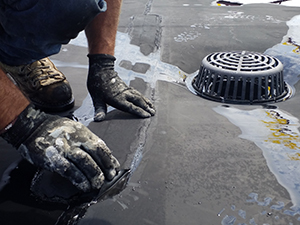
A properly executed EPDM repair starts with thorough surface preparation. The repair area must be cleaned of dirt, oxidation, and any residual contamination that would prevent adhesive bonding. On aged EPDM, this typically means using an EPDM primer before any adhesive or patch material is applied. The patch itself should be cut from a compatible EPDM membrane with adequate overlap on all sides of the damaged area. Lap adhesive is applied to both surfaces and allowed to reach proper tack before the patch is pressed and rolled to eliminate voids. Seam tape is applied at the patch perimeter to complete the seal. The ambient and membrane temperature during application must fall within the adhesive manufacturer’s specified range. Below that range, adhesive does not cure correctly and the bond is compromised from day one. None of this is complicated, but all of it requires a technician who knows the material and follows the process.
Expert Murfreesboro Rubber Roof Repair
A rubber roof repair that fails six months after it was done is not a savings. It is a second bill on top of the first one. At Glick Roofing Systems, we repair EPDM and rubber roofing systems across Murfreesboro, TN with the material knowledge and technique that produces repairs that actually hold. Call us at (800) 821-0205 and let us assess what your roof needs before the next Tennessee storm puts it to the test.
FAQ
How long does an EPDM rubber roof typically last on a commercial building in Tennessee?
Well-installed EPDM systems on commercial buildings commonly achieve 20 to 25 years of service life with periodic maintenance and prompt attention to minor repairs.
Can a rubber roof be repaired in cold weather in Murfreesboro?
EPDM adhesives require minimum application temperatures, typically above 40 to 50 degrees Fahrenheit, so cold weather repairs require careful timing and may need supplemental heating.
Is rubber roof repair covered under a commercial building insurance policy?
Storm-related EPDM damage is typically covered under commercial property insurance, though wear-related failures and maintenance issues are generally excluded.
At what point does rubber roof repair stop making sense compared to replacement?
When failures are widespread across the membrane field rather than isolated, or when wet insulation is present in multiple zones, the scope of repair typically exceeds the cost of replacement.