

Nashville gives a commercial roof three distinct workloads in a single year: a storm-heavy spring, an intensely sunny summer, and a winter that freezes and thaws repeatedly. Each one damages a rubber membrane in its own way, and the signs rarely look alike. Rubber roof repair is most effective when it follows that calendar instead of waiting for a leak to set the schedule.
Call Glick Roofing Systems at (800) 821-0205 for rubber roof repair in Nashville, TN.
Rubber Roof Repair Follows the Storm Calendar
Middle Tennessee storm season runs hardest from March through June, and it produces most of the sudden damage a rubber roof will see all year.
Hail bruises the membrane at the point of impact, thinning it without necessarily opening it. Those bruises often leak months later, which is why a post-storm inspection is worth far more than waiting to see what happens.
High wind attacks the edges, lifting perimeter metal, peeling loosely adhered flashing, and driving debris across the surface. Any of those can leave a puncture that stays invisible from inside the building.
Summer Sun Ages the Membrane from Above
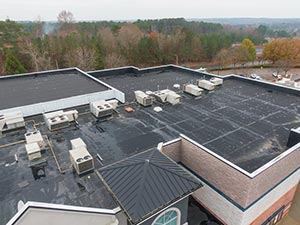
Ultraviolet exposure gradually degrades an exposed rubber membrane, causing it to harden and lose some of the flexibility it needs.
A hardened membrane no longer follows the roof’s movement. Small cracks appear where the material is asked to flex most, along seams, at curb corners, and around penetrations.
Heat compounds it. A dark rubber surface can run far above air temperature on a July afternoon, so the daily expansion swing is wider than owners expect and the seams take the strain.
Rubber Roof Repair After Freeze-Thaw Season
Winter damage works through water rather than cold alone. Water can enter small openings or damaged areas, and repeated freezing and thawing can enlarge existing defects and make them more difficult to keep watertight.
Repeat that across a Nashville winter and a small opening becomes a real one. Flashings at walls and curbs are the usual casualties, along with sealant at penetrations that already hardened over the summer.
Blocked drains make it worse. Water that cannot leave sits on seams while it freezes and thaws, which makes clearing drains before winter one of the cheapest preventive steps available.
Knowing What Each Season Left Behind
Different damage calls for different repairs. Hail damage may require localized repair or replacement of the affected membrane, depending on its severity.
Hardened or extensively cracked membrane across a wide area requires a broader evaluation. Depending on the membrane’s condition, a restoration coating, more extensive repair, or replacement may make more sense than continued spot patching.
Two inspections a year, one after storm season and one before winter, catch each type while it is still local. Waiting for a ceiling stain means the insulation has been wet for a while.
Keeping a dated record of each repair also helps with insurance, since it separates new storm damage from wear that was already present.
Rubber Roof Repair Keeps Nashville Buildings Covered
A rubber membrane can serve a building for decades, but only when the damage each season leaves behind is addressed before the next season adds to it.
We use Roof MRI scanning to find moisture under the surface before recommending repairs, so the work matches the actual condition rather than the visible symptom. For rubber roof repair in Nashville, TN, contact Glick Roofing Systems at (800) 821-0205 today.
FAQ
How can I tell if hail damaged my commercial rubber roof?
Look for circular bruised spots, scattered surface loss, and dents in rooftop metal such as vents and edge trim. Much of it does not leak right away.
How soon after a storm should a commercial roof be inspected?
Within a few weeks. Damage is easiest to document while fresh, and most insurance policies tie filing deadlines to the date of the storm.
Can a rubber roof be repaired in cold weather?
Most repairs can, though adhesives and sealants carry minimum temperature requirements. Emergency work happens year round and permanent repairs may wait for a warmer, dry window.