

Nashville’s commercial buildings sit under flat and low-slope roofs that spend the year moving. They expand through long, hot summers and contract on cold winter nights, and every one of those cycles works at the membrane. A rubber roof coating is one of the few protective options built to move with the roof rather than resist it.
For related commercial roofing guidance in Nashville, see Flat roof waterproofing in Nashville and EPDM roof repair in Nashville.
Call Glick Roofing Systems at (800) 821-0205 for rubber roof coating in Nashville, TN.
Rubber Roof Coating Stretches Instead of Cracking
An elastomeric coating cures into a rubber-like film that can stretch and return to shape, which is exactly what a flat roof demands of anything applied to it.
Coatings that lack sufficient flexibility can be more prone to cracking as the roof expands and contracts, particularly around seams, fasteners, and other areas that experience concentrated movement.
The daily swing is wider than most owners expect. A dark membrane in a Tennessee July can run well above the air temperature and cool sharply after sunset, and a film that moves through that range stays intact where a brittle one splits.
Adhesion Decides Whether a Rubber Roof Coating Lasts
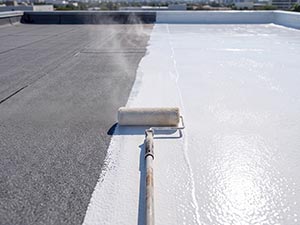
A coating performs only as well as its bond to the surface underneath, and that bond is won or lost during preparation.
Preparation means washing the roof, removing chalking and loose material, repairing open seams, replacing wet insulation, and priming where the existing membrane calls for it. Ponding areas get corrected first, since a coating over standing water will not cure properly.
An aging membrane can still be a good coating candidate when its underlying structure is sound and the surface can be properly cleaned, repaired, and prepared.
Rubber Roof Coating Handles the Summer Sun
Ultraviolet exposure is the main thing that ages an exposed roof, breaking down the surface, driving chalking, and removing the flexibility the membrane started with.
A quality elastomeric coating absorbs that UV load so the membrane below stops taking it, which is the practical reason coated roofs age more slowly than uncoated ones.
Reflectivity comes with it. A white coating returns a large share of solar energy instead of storing it, which lowers peak roof temperature and eases the load on rooftop cooling equipment through a Nashville summer.
Seams Are Where Leaks Usually Start
Laps between sheets, flashings at walls and curbs, and seals around penetrations are common areas for leaks to develop.
A coating changes that geometry. Applied across the whole roof with reinforcing fabric worked into the joints, it produces a seamless surface with no laps left for water to work at.
That continuity is the main protective gain. Instead of dozens of joints each holding on their own, the roof presents one uninterrupted layer.
Coatings do not repair structure. If the insulation below is saturated or the deck has failed, those areas get replaced before any coating is applied.
Rubber Roof Coating Protects Nashville Roofs
For an owner with a weathered but structurally sound roof, a coating restores protection without a tear-off, without disposal, and with less disruption to building operations than a full tear-off may require.
Before recommending one we scan for trapped moisture with Roof MRI technology, and finished work carries our Glick-Guard warranty with no-dollar-limit coverage on labor and materials. For rubber roof coating in Nashville, TN, contact Glick Roofing Systems at (800) 821-0205 today.
FAQ
Can a rubber roof coating be applied over an existing TPO or EPDM roof?
Usually yes, provided the membrane is dry, sound, and properly cleaned and primed first. Compatibility depends on the existing system and gets confirmed during the inspection.
How many coats does a commercial roof coating need?
The number of coats depends on the specific coating system and required dry-film thickness. Some systems use multiple coats, with reinforcing fabric incorporated at seams and penetrations where specified.
What temperature is needed to apply a roof coating?
Application temperatures depend on the specific coating system, but the manufacturer’s minimum temperature requirements and weather conditions must be followed. In Tennessee, spring through fall often provides the most favorable application conditions.