

Nashville gets substantial rainfall spread across the year, along with the humidity that comes with it, and a flat commercial roof has to withstand both conditions. Flat roof waterproofing covers the systems that keep that water out, and the differences between those systems become more apparent over years of performance rather than on the day of installation.
For related commercial roofing guidance in Nashville, see Rubber roof coating in Nashville and EPDM roof repair in Nashville.
Call Glick Roofing Systems at (800) 821-0205 for flat roof waterproofing in Nashville, TN.
Flat Roof Waterproofing Challenges
A low slope roof cannot rely on gravity the way a pitched roof does. Water moves slowly across it and sits at any low spot, which means the surface has to be continuously sealed rather than layered to shed runoff.
Middle Tennessee adds its own challenges. Heavy rain events can deliver water faster than drains can remove it, humidity keeps surfaces damp longer, and summer heat and winter freeze cycles place added stress on the material at every seam and transition.
Sheet membranes are the most common answer, and they work by keeping joints to a minimum.
Membrane Systems and How They Shed Water
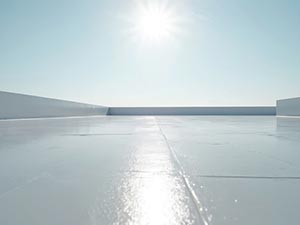
Single-ply membranes are installed in wide sheets and joined at the seams, either heat welded or chemically bonded, to form one continuous surface across the roof field.
Much of their waterproofing strength comes from minimizing joints. Fewer seams mean fewer places for water to work in, and the seams that exist are engineered connections rather than overlaps. The material also stays flexible enough to move with the building through temperature swings.
Their vulnerability is at the details. Penetrations, curbs, and drain flashings are where a membrane roof requires careful installation, since those transitions are the points a wide sheet cannot cover on its own. Fluid-applied systems address the same challenge in a different way.
Fluid-Applied Coatings and Spray Foam
Fluid-applied coatings are applied as a liquid and cure into a seamless membrane that follows the shape of everything it covers. Because there are no seams anywhere, including at penetrations, the detail vulnerability of a sheet system largely disappears.
Coatings are commonly used to renew an aging roof rather than replace it, and reflective versions reduce the surface temperature that drives material aging in Tennessee summers.
Spray polyurethane foam is applied as a liquid that expands into a rigid insulating layer, then receives a protective coating. It provides waterproofing and insulation in a single application, and because it can be built up in thickness, it corrects ponding areas by filling low spots that would otherwise hold water. System choice matters, but it is rarely the only factor determining how long a roof lasts.
What Determines How Long Flat Roof Waterproofing Lasts
Drainage has a greater impact on roof longevity than any other factor. Water that drains from the roof within a day or two after a storm creates far less risk than water that remains for a week. Undersized or blocked drains shorten the life of any system regardless of quality.
Installation quality at the details is second. Most leaks on a commercial roof start at a penetration, a curb, or an edge rather than in the open field, and those are the areas where workmanship shows.
Maintenance is the third major factor and the one property owners can control most directly. Keeping drains clear, addressing small openings before they spread, and inspecting after major storms helps a system remain on track for its expected service life. Neglect turns a twenty-year roof into a ten-year roof.
Getting Flat Roof Waterproofing Right
No single system is the answer for every building. The right choice depends on the existing assembly, the drainage situation, the rooftop equipment, and how long you plan to hold the property. Just as important is what stands behind the work, which is why our Glick-Guard warranty is written in plain terms with no dollar limit on covered leaks.
For flat roof waterproofing in Nashville, TN, contact Glick Roofing Systems at (800) 821-0205 today.
FAQ
How do you test a flat roof for leaks?
Infrared scanning finds trapped moisture by reading surface temperature differences, and controlled flood or spray testing confirms the entry point.
Can flat roof waterproofing be applied in winter?
Membrane work continues in cold weather. Coatings and foam have minimum temperature and moisture requirements, so those applications are usually scheduled during milder weather.
Does ponding water always mean the roof is failing?
Not necessarily, though water remaining more than about two days after rain points to a drainage problem worth correcting.