
Spring Hill has grown into a Middle Tennessee hub for auto manufacturing, distribution, retail centers, and healthcare. Each building type puts different demands on its roof. TPO roofing is one of the most-installed commercial membranes across the region, but it is not the right match for every project. Call Glick Roofing Systems at (800) 821-0205 for TPO roofing in Spring Hill, TN.
TPO Roofing Fits Some Buildings Better Than Others
Building fit comes down to four questions. What is the roof’s exposure to heat, sun, and thermal cycling? What kind of foot traffic and rooftop equipment does the roof carry? What is coming out of the exhaust vents onto the membrane? And how tight is the tear-off and re-cover schedule going to be?
TPO roofing handles the first two questions unusually well. The heat-welded seams stay bonded through the summer expansion and contraction that Middle Tennessee puts every membrane through. The white reflective surface holds up under direct sun and drops cooling loads inside. Where the answers to the second two questions get complicated, TPO may still fit, or another system may fit better.
Warehouse and Distribution Buildings Match TPO Roofing Well

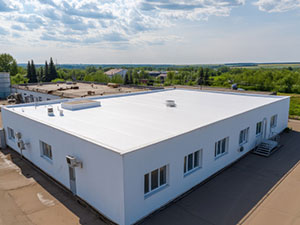
Large-footprint warehouses and distribution centers are where TPO roofing earns its reputation. These roofs cover tens of thousands of square feet with few penetrations, minimal foot traffic, and long unbroken planes. TPO installs go down fast on that geometry, and the heat-welded seams create one continuous waterproof surface across the whole roof.
Thermal cycling is the real test on a big warehouse. Middle Tennessee summers push rooftop temperatures well past what the ambient reading suggests, then night cooling contracts everything back. A welded seam handles that cycle better than any adhered seam that relies on chemical bond. Distribution operators want a roof they do not have to think about, and TPO delivers on that.
Retail and Office Buildings Value the Cooling Load Drop
Retail strip centers and office buildings across Spring Hill run hard on HVAC through the summer. A dark or aged membrane pushes cooling costs higher every year. A white TPO membrane stays reflective, so surface temperatures drop compared to darker alternatives. That carries through inside as lower cooling load and slower HVAC cycling. For an owner tracking operating cost over the life of the roof, that reflective surface is a real line item.
Where TPO Roofing Is the Wrong Fit?
Not every commercial building is a TPO candidate. Restaurants and food processors with heavy grease exhaust need a membrane that resists animal fats better than TPO does. Buildings with chemical exhaust or petroleum vapor call for the same rethink. In those cases a PVC membrane or a spray foam system with a coating on top usually holds up longer.
Buildings with irregular geometry, deep parapets, or dozens of small penetrations sometimes suit a fluid-applied system better than a sheet membrane. And a roof with saturated insulation is not a TPO candidate at all until the wet substrate is replaced. Building fit is honest, and it saves owners from paying for the wrong system.
TPO Roofing in Spring Hill Comes Down to Building Profile
The right way to answer whether TPO roofing fits a building is to look at the building itself, not the price sheet. A walk of the roof, an assessment of what the vents are exhausting, and a moisture scan of the substrate tell the real story.
For TPO roofing in Spring Hill, TN, contact Glick Roofing Systems at (800) 821-0205 today.
FAQ
How long does a TPO roof usually last on a Middle Tennessee commercial building?
A properly installed TPO roof lasts twenty to thirty years in this climate. Membrane thickness and quality of the initial install drive the top end of that range.
Can a TPO roof be walked on for HVAC service?
Yes, but the membrane benefits from walk pads on the paths crews use most often. Concentrated foot traffic without pads wears the surface faster.
Does the color of a TPO membrane matter for a Tennessee building?
White is the standard and delivers the cooling benefit. Gray and tan are available for aesthetic reasons but give up some of the reflective performance.