

Spring Hill’s commercial building stock has grown rapidly over the past decade, and so has the demand for roofing systems that handle Tennessee’s year-round moisture. EPDM roofing is widely used on flat and low-slope commercial roofs, where a continuous membrane helps protect against water intrusion. Glick Roofing Systems installs and services EPDM across Middle Tennessee for property owners who need a membrane that performs through every season. Call us at (800) 821‑0205 for EPDM roofing in Spring Hill, TN.
How EPDM Roofing Helps Prevent Water Intrusion
EPDM is a synthetic rubber membrane, and its composition provides the first line of waterproofing defense. The material is nonporous, which means water does not pass through an intact sheet under normal conditions. Keeping the membrane intact and its seams secure is essential to preventing water from reaching the underlying roof assembly.
A single EPDM sheet can cover large sections of a roof with minimal seams. Fewer seams mean fewer potential entry points for water, which can simplify maintenance over the life of the roof. The sheets themselves are manufactured in widths up to fifty feet, so a small to midsize commercial building in Spring Hill may only need a few seams across the entire roof surface.
How the Seams Hold Against Thermal Cycling
Seams are potential points of water entry on a single-ply roof. EPDM seams are joined using specialized adhesive or seam tape systems designed to create a watertight connection between membrane sheets.
A dark roof membrane can become much hotter than the surrounding air in summer, while winter temperatures in Spring Hill can drop below freezing. These changes cause roofing materials to expand and contract. EPDM’s rubber composition provides flexibility to accommodate that movement. Proper installation and ongoing maintenance help EPDM seams remain secure through repeated thermal movement.
Flashing Details Protect the Weak Points on an EPDM Roof
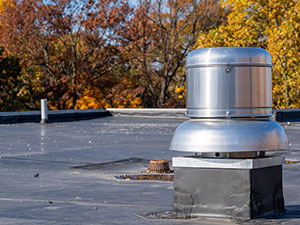
Commercial roofs commonly have penetrations for HVAC equipment, vents, pipes, and drains. These details require careful sealing to prevent water entry. On an EPDM roof, each penetration requires a compatible flashing detail suited to its shape and function.
Compatible flashing helps accommodate movement at membrane transitions. Proper detailing remains essential to preventing leaks. At perimeter edges, termination bars and compatible sealants help keep the membrane anchored and watertight. These connections require inspection because movement, weathering, or physical damage can affect their performance.
Long Term Performance of EPDM Roofing
EPDM has a long history of use on commercial roofs exposed to weather and thermal movement. For Spring Hill property owners, its flexible membrane provides a practical waterproofing option when combined with sound installation details, effective drainage, and routine maintenance. For EPDM roofing in Spring Hill, TN, contact Glick Roofing Systems at (800) 821‑0205 today.
FAQ
What are the most common problems with EPDM roofs?
Shrinkage can pull the membrane away from edges and penetrations, while foot traffic and debris can cause punctures. Localized problems may be repairable when identified during routine inspections.
How long does an EPDM roof last on a commercial building?
A properly installed EPDM membrane can provide decades of service. Its lifespan depends on installation quality, membrane condition, exposure, and consistent maintenance.
Is EPDM better than TPO for keeping water out?
Both membranes can provide effective waterproofing when properly installed and maintained. The choice between EPDM and TPO depends on the roof’s design, installation requirements, and operating conditions.