
Picking a commercial roofing system is really a money decision stretched over twenty years or more. For building owners in Bowling Green, KY, single-ply roofing tends to win that math. At Glick Roofing Systems, we install single-ply systems on commercial buildings across Kentucky and surrounding states. Call us at (800) 821-0205 to talk through the numbers on your building.
For related commercial roofing guidance in Bowling Green, see Rubber roof coating in Bowling Green and TPO roofing in Bowling Green.
The True Cost of Single-Ply Roofing
The true cost of single-ply roofing is not the install price. It is what the roof costs you to own across its whole life. Single-ply is one sheet of membrane laid over the roof. This is quite different from the traditional approach of stacking layers as part of a built-up system. Single-ply roofing is cheaper to put down and cheaper to keep up.
In this article we break down the upfront cost picture, what single-ply saves over the years, and how the membrane you pick moves the total. The goal is to help you think like an owner, not just a buyer. Once you see the full picture, single-ply usually looks even better than the bid suggested.
Why Single-Ply Roofing Costs Less to Install
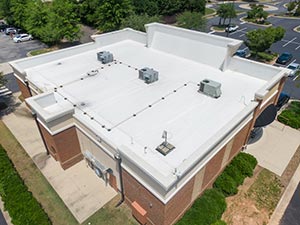
Single-ply roofing costs less to install than most multi-layer systems because there is simply less to it. A built-up roof stacks several layers of felt and asphalt, which takes more material, more labor, and more time on the roof. Single-ply goes down in large sheets that cover ground fast. That single layer is the whole idea behind the system, and it is where the name comes from.
Fewer layers also means less weight on the structure and a shorter project, which keeps your building running while the work happens. On a large flat commercial roof, that speed and simplicity show up directly in the install price. Less time on the roof also means less disruption to whatever your building does each day.
What Single-Ply Roofing Saves Over Its Life

Single-ply roofing systems save money through durability and low upkeep requirements. A quality membrane shrugs off sun, weather, and the daily temperature swings that age a roof, so it needs less attention year to year. The seams are welded into one continuous surface, which removes the joints where leaks and repair bills usually start. Welded seams are the single biggest reason single-ply outlasts the patched-together roofs it often replaces.
Here is the part owners underestimate. A roof that rarely leaks does not just save on repairs. It protects everything under it, from insulation to inventory, and avoids the slow water damage that quietly runs up the real bill on a neglected roof. Over twenty years, the roof that almost never bothers you is almost always the cheaper one.
How the Membrane You Choose Drives Lifetime Cost
The membrane you choose is the biggest lever on total cost, and it is where the cheapest bid can fool you. Single-ply comes in different thicknesses, measured in mils, which is just thousandths of an inch. A thinner membrane costs less today but wears through faster under foot traffic and rooftop equipment.
A thicker membrane costs more up front but often lasts years longer, which lowers the cost spread across the roof’s life. The right call depends on your building. A roof with heavy equipment access is a different decision than a roof nobody walks, so we match the membrane to how the roof actually gets used. Spending a little more on the membrane is often the cheapest decision you make across the life of the roof.
Single-Ply Roofing as a Long-Term Investment
Looked at over its full life, single-ply roofing is one of the most cost-effective commercial roofs you can put on a building. It installs efficiently, holds up with little fuss, and lets you tune the membrane to your budget and your building’s demands. It is the rare upgrade that gets easier to justify the longer you own the building.
At Glick Roofing Systems, we help Bowling Green, KY owners weigh the real cost of single-ply roofing, not just the number on the install. Call us at (800) 821-0205 to walk your roof and talk options.
FAQ
How does the cost of single-ply roofing compare to other commercial flat roof systems?
It usually installs for less than built-up or modified bitumen systems and lands near or below most metal options on a flat roof.
What factors most affect the long-term value of a single-ply roofing system?
Membrane thickness, install quality, and how well the seams are welded matter most, along with keeping the drains clear.
How long does a single-ply commercial roof typically last before it needs to be replaced?
Most last around 20 to 30 years depending on thickness, sun exposure, and how much rooftop traffic the membrane takes.