
When a commercial flat roof keeps leaking no matter how many times it gets patched, it may be time for a different approach. Spray foam roofing is often brought in to solve the problems conventional roofs cannot shake. At Glick Roofing Systems, we install spray foam systems on commercial buildings around Bowling Green, KY. Call us at (800) 821-0205 to see if it fits your roof.
For related commercial roofing guidance in Bowling Green, see Single-ply roofing in Bowling Green and TPO roofing in Bowling Green.
When Spray Foam Roofing Is the Right Fix
Spray foam roofing is the right fix when a flat roof has chronic leaks, tricky rooftop penetrations, or too little insulation, and you would rather not tear the whole thing off. Spray polyurethane foam, often shortened to SPF, goes on as a liquid and expands into a solid, seamless layer across the entire roof.
That seamless quality is what lets it solve problems other roofs create. Below we walk through the three issues owners bring it in for, and what the install actually involves.
How Spray Foam Roofing Stops Chronic Leaks
Spray foam roofing stops chronic leaks by covering the roof in one continuous layer with no seams to fail. On most flat roofs, leaks start at the seams between sheets and around the edges, where water works at the joints over time. Foam removes those joints entirely. It bonds to the existing roof and forms a single sealed surface, so there is no longer a seam or lap for water to slip through. Foam also flexes with the building as it expands and contracts, so it does not crack at the spots a rigid patch would. For a building that springs a new leak every storm, that is often reason enough to switch.
The Penetration Problem Spray Foam Roofing Solves

Spray foam roofing solves the penetration problem by flowing around obstacles and sealing them in one pass. Here is what most owners do not realize. Every pipe, vent, curb, and equipment stand on a roof is a spot where a sheet membrane has to be cut, fitted, and flashed by hand, and each of those details is a future leak waiting to happen.
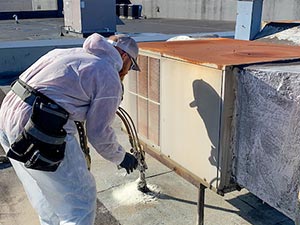
Foam is sprayed, so it can conform tightly around penetrations and reduce many of the seams, laps, and hand-fit details that create leak risks in sheet systems. The more cluttered your rooftop is, the bigger that advantage gets. Buildings packed with rooftop equipment are exactly where foam tends to outperform a sheet system.
How Spray Foam Roofing Adds Insulation Without a Tear-Off
Spray foam roofing adds insulation directly, because the foam itself is one of the better insulators available. A sheet membrane keeps water out but adds almost no thermal value on its own. Foam does both jobs at once. It builds R-value, the measure of how well a material resists heat flow, right into the waterproofing layer. And because it goes on top of the existing roof, you get that insulation without the cost and mess of a full tear-off first.
What Spray Foam Roofing Installation Looks Like
A spray foam roofing installation is faster and cleaner than a tear-off, and it follows a clear sequence. We prep the existing roof, build up the foam, then protect it.
The process is straightforward on a commercial building. We start by cleaning and prepping the existing roof, repairing wet or damaged areas and confirming the surface is dry. Then we spray the polyurethane foam in an even layer, building it up to the planned thickness and slope. A protective top coating goes over the foam to guard it from sunlight and weather. We finish with an inspection to confirm full coverage and a complete seal before signing off.
Spray Foam Roofing for a Roof That Keeps Failing
For an aging flat roof that leaks, fights its penetrations, and runs short on insulation, spray foam roofing tackles all three in a single application. It seals the roof, insulates it, and skips the tear-off, which is why so many commercial owners turn to it.
At Glick Roofing Systems, we assess flat roofs across Bowling Green, KY and tell you whether spray foam roofing is the right call. Call us at (800) 821-0205 to set up a professional evaluation
FAQ
Can spray foam roofing be applied over an existing flat roof without a full tear-off?
Yes, foam goes over a sound, dry existing roof with no tear-off, though a saturated or failing deck has to be replaced first.
Does spray foam roofing add weight to the building’s roof?
No, the foam is very lightweight and adds little load, which is part of why it works so well as an overlay on an existing roof.
How long does a spray foam roof last, and what maintenance does it require?
It can last decades and needs a recoat roughly every 10 to 15 years to keep the topcoat protecting the foam.